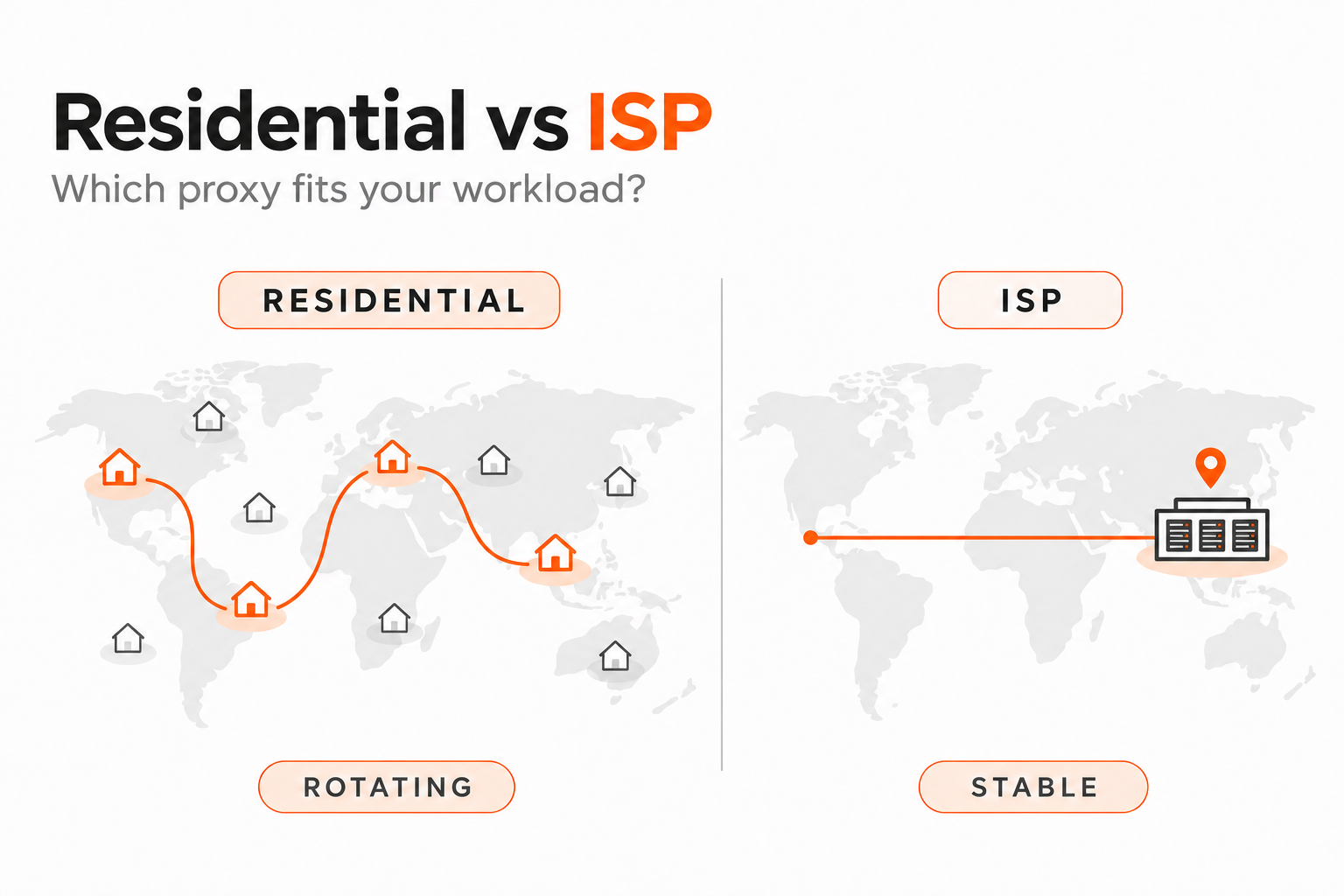
Residential and ISP proxies can both present an ISP-associated address to a destination, but they are built for different operating patterns. A rotating residential pool is a candidate when a job needs many locations or independent IPs. An ISP proxy is a candidate when the same permitted workflow needs a persistent address. Neither type guarantees access, speed or a lower total cost on every target.
The right choice comes from the workload: how long identity must remain stable, which locations are required, how much data moves, and how many validated results you get for the money spent. This guide offers a comparison and a small pilot method instead of an unverified “winner.”
What each term means
A residential proxy generally routes requests through an IP assigned to a household internet connection. Pool products commonly offer rotation and sometimes a time-limited sticky session. Availability of an individual peer can change, so a sticky session should not be treated as a permanent IP. IP Fist's residential page describes rotation and location selection for its residential product.
An ISP proxy usually uses an ISP-registered address on hosted infrastructure. Many providers market it as a static residential proxy. “Static” describes address assignment, not a guarantee that every request in a product uses only one address. A provider may offer several fixed addresses or a way to rotate among them. Bright Data and Decodo describe the category in these terms; check each product's actual allocation and sharing rules.
These are product categories, not security grades. Source network, IP reputation, browser/session behavior and the target's access rules all affect outcomes. Avoid assuming that an ISP label automatically means a household device or that a residential label means one unchanging user identity.
Residential vs ISP: the decision matrix
| Decision factor | Residential pool | ISP proxy |
|---|---|---|
| Exit source | Typically a pool of household connections; available peers and locations vary. | ISP-registered addresses on hosted infrastructure; allocation varies by plan. |
| IP continuity | Often rotating; sticky sessions may preserve an exit temporarily, subject to availability. | Typically fixed address allocation; plan may be dedicated or shared. |
| Geographic sampling | Often a stronger fit when many regions or independent exits are required, if stocked. | Often a stronger fit when a smaller number of stable, specific locations is enough. |
| Long workflows | Possible with a supported sticky session, but verify maximum duration and interruption behavior. | Often easier when an approved workflow needs the same address over time. |
| Billing question | Check metered bandwidth, request accounting, minimums and expiration. | Check per-IP or subscription fees, traffic terms, sharing and replacement policy. |
| Main failure mode to test | Session changes or peer availability interrupt a job. | One address or subnet may become a concentrated failure point. |
This table describes common product patterns, not guaranteed IP Fist specifications or a benchmark. The plan's real terms take precedence. IP Fist ISP presents stable sessions as a product use case, while its residential product emphasizes rotation and geographic selection.
Start with the constraint that cannot move
When identity must stay consistent
A login, account administration or other authorized multi-step workflow may require the same exit address across steps. Prefer a documented fixed ISP allocation when the address must survive for a long period. If a residential sticky option is considered, test whether it lasts for the full workflow and what happens if the peer disconnects. Session continuity also depends on cookies and application state; IP alone is not the whole identity.
When you need varied locations or independent exits
For permitted regional QA, ad verification or collection of public information across many markets, a residential pool may offer more suitable location variety. Confirm that each required country or city actually has available exits and that the plan supports the requested targeting level. A large advertised country count does not guarantee capacity for a narrow city at the time you run the job.
When bandwidth or traffic is heavy
Do not infer the cheaper option from a per-GB or per-IP headline. Estimate total transferred bytes, fixed fees, retry traffic, and any fair-use terms. The IP Fist bandwidth guide explains why background requests and unsuccessful attempts matter. Product pricing can change, so use the current plan terms rather than a copied example price.
Measure cost per validated result
A useful comparison is total attributable cost ÷ validated results, with a clearly defined result. For a price-monitoring job, for example, a result might need the correct market, product ID, currency, timestamp and a parseable price. HTTP 200 alone is not enough. Include plan fees, billed traffic and retry costs in the numerator; include only records that pass your quality checks in the denominator.
Run a short pilot on both products using the same authorized targets and time window. Keep the page set, geography, payload, client configuration and concurrency comparable. Otherwise you are measuring a different job, not a proxy choice.
| Metric | How to record it | Why it matters |
|---|---|---|
| Validated result rate | Useful records ÷ attempted tasks, with validation rules defined first. | Separates usable data from successful HTTP transport. |
| P95 end-to-end time | Time from task start to validated result; report sample size. | Shows the slower tail that affects deadlines. |
| Session continuity | Number and cause of mid-workflow identity changes or resets. | Critical for long, stateful tasks. |
| Cost per validated result | All attributable fees and metered use ÷ useful records. | Compares plans with different billing models. |
| Targeting availability | Share of required locations available during the pilot. | Prevents a broad coverage claim from hiding a narrow-location gap. |
Use enough repeated tasks to represent normal variation, and state the sample size and test window. There is no universal success-rate or latency ranking between residential and ISP proxies; outcomes depend on the target, location, provider and task design. Stop a pilot that violates a target's access limits instead of increasing request volume to force a result.
Three practical choices
For a long, authorized seller-account workflow, start with a stable ISP address and test session continuity. The IP Fist ISP page describes long-session applications. Keep a separate address per account only where the platform's rules permit that setup.
For public-price sampling across many markets, start by checking residential location availability and rotation controls. Validate extracted prices and measure traffic, because failed pages and duplicate media downloads can change the cost materially.
For monitoring a small set of public pages in one region, test both. A fixed ISP address may simplify scheduling; a residential pool may be useful if the task needs independent regional viewpoints. Choose by measured useful results and plan terms, not a generic “best proxy” label.
How to compare the two products in IP Fist
Use the current IP Fist documentation and dashboard-generated configuration for each product. Keep endpoint, credentials and session parameters paired with the correct product. First verify connectivity using a low-volume authorized request, then run the same pilot checklist for both products.
If a request returns 407, resolve authentication using the 407 guide. If it returns 429, investigate the responding service, rate policy and Retry-After. The proxy type should not be changed solely to mask a configuration or rate-limit problem.
Frequently asked questions
Are ISP proxies the same as static residential proxies?
The terms often overlap in vendor marketing, but inspect the contract. Confirm where the address is registered and hosted, whether it is shared or dedicated, how long it remains assigned, and whether you can rotate among purchased addresses.
Can a residential proxy keep the same IP?
Some products support sticky sessions for a limited time. The same IP can still disappear if the underlying peer becomes unavailable. Confirm the provider's session duration and recovery behavior for your exact plan.
Are ISP proxies always faster or residential proxies always more successful?
No universal guarantee follows from the category name. Route length, target behavior, location, connection reuse and application logic can dominate. Compare both with the same workload and report tail latency, validated results and cost.
Sources and scope
Category definitions and product patterns were checked against Bright Data's comparison, Decodo's 2026 guide, and the current IP Fist residential and ISP product pages on November 9, 2026. The pilot framework is editorial guidance; this article does not claim a live head-to-head benchmark or verified performance numbers for either product.