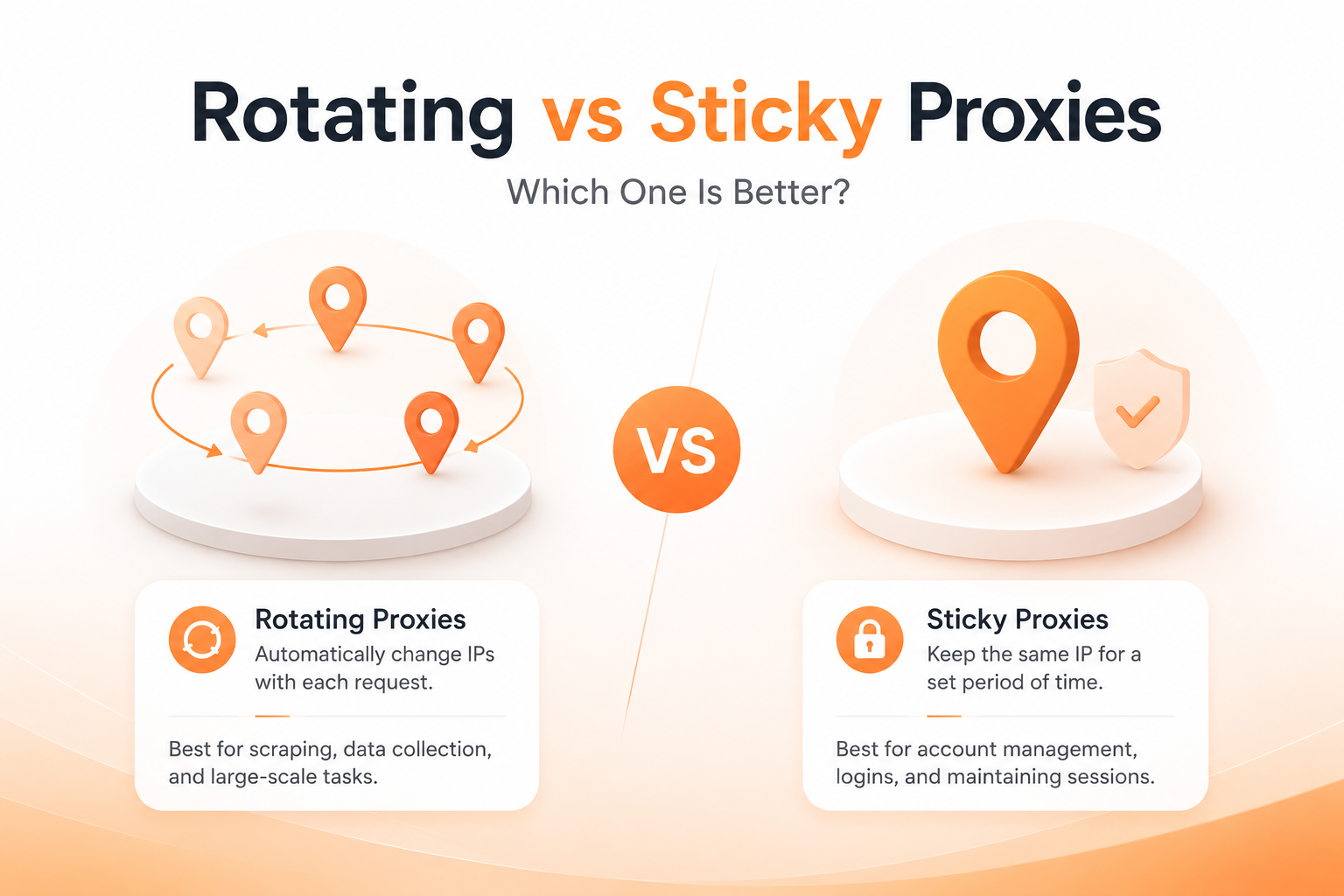
Choosing between rotating and sticky proxies is one of the most important decisions when designing any proxy-driven workflow. The right pick depends entirely on what your traffic needs to look like to the target site — a constantly changing crowd, or a single trusted identity. Get this wrong and even the best proxy pool in the world will look suspicious; get it right and most anti-bot systems will simply wave you through.
What is a Rotating Proxy?
A rotating proxy automatically changes the exit IP on every request, or after a short interval. Each connection looks like it comes from a fresh user in a fresh location, pulled from a large pool of residential, mobile, or datacenter IPs.
Under the hood, the proxy gateway holds a session pool and assigns a new exit on demand. Some providers rotate per request (every single HTTP call gets a new IP), others rotate by time (every 30 seconds, every 5 minutes), and the better networks let *you* decide via a parameter in the username or endpoint. The size and quality of the pool is what actually matters — a 1M+ pool spread across hundreds of ASNs and dozens of countries behaves very differently from a recycled 5K pool that everyone else is also hammering.
Best for:
- Large-scale web scraping: distribute millions of requests across thousands of IPs to avoid rate limits and blocks.
- Data collection & price monitoring: pull public data from e-commerce, travel, real estate, and marketplace sites without hammering a single IP.
- SEO & SERP tracking: query search engines from many regions to capture localized rankings.
- Ad verification: rotate identities to validate ad delivery, placements, and creative across geos.
- Market research: aggregate public signals at scale without leaving a recognizable fingerprint.
What is a Sticky Proxy?
A sticky proxy keeps the same IP for a defined session — anywhere from a few minutes to the full lifetime of the IP. The target site sees one consistent user returning over time, with the same geolocation, ASN, and TCP/TLS fingerprint on every request.
Sticky sessions are usually controlled by a session token embedded in the proxy username (for example user-session-abc123). As long as you reuse that token, the gateway hands you the same exit IP. When the TTL expires or the underlying device drops, the session ends and a new IP takes its place. For account-driven workflows this is non-negotiable — a single IP swap mid-checkout is often enough to trigger a captcha, a 2FA challenge, or a hard ban.
Best for:
- Account logins & management: stay on the same IP so platforms don't trigger re-verification, captchas, or security challenges.
- Multi-account operations: pair one account with one stable IP to avoid cross-contamination.
- Long-running sessions: keep cookies, tokens, and shopping carts valid from start to finish.
- Checkout flows: complete sneaker drops, ticket purchases, and limited-stock buys without an IP change breaking the session.
- Social media automation: post, comment, and engage from a stable identity that platforms learn to trust.
Side-by-side Comparison
| Aspect | Rotating Proxy | Sticky Proxy |
|---|---|---|
| IP behavior | Changes per request or short interval | Same IP for the whole session |
| Best for | Scraping, data collection, SERP | Logins, checkout, account ops |
| Session continuity | Low — each request is a new identity | High — cookies and tokens persist |
| Anti-bot footprint | Spreads load across many IPs | Looks like a real, returning user |
| Throughput | Very high, parallel friendly | Limited by single-IP rate limits |
| Typical cost model | Pay per GB or per request | Pay per IP / per session time |
| Geo precision needed | Country level is usually enough | City / ASN level often required |
| Failure mode | One bad IP, retry on the next | Session dies, restart the workflow |
How Rotation Actually Works
A rotating endpoint is not magic — it is a load balancer in front of a managed pool. When your request hits the gateway, it picks an exit based on your targeting parameters (country, city, ASN), forwards the traffic, and returns the response. If you fire 1,000 parallel connections, you may use 1,000 distinct IPs in a single second. This is what makes rotating proxies so effective for read-heavy work: the target site sees noise, not a pattern.
The trade-off is that each request starts from scratch. There are no warmed-up cookies, no prior browsing history, and no consistent fingerprint. If the target site relies on session state — even something as basic as a CSRF token tied to an IP — rotating traffic will fail in confusing ways.
How Sticky Sessions Actually Work
Sticky sessions trade scale for continuity. You ask the gateway for a session token, and it pins your traffic to one exit IP for the duration of that session. Residential sticky sessions usually have a TTL (commonly 1, 10, or 30 minutes), while ISP and datacenter sticky IPs can stay assigned for hours or indefinitely.
The catch is that real residential devices can disconnect at any time. A good provider will gracefully rotate you to a new IP from the same region when the device drops, but your code still needs to handle "session ended" errors and decide whether to retry on a new session or fail. For sneaker drops and other high-stakes checkout flows, many teams pre-warm a pool of sticky sessions before the drop opens, so they never have to wait on a fresh assignment.
Common Pitfalls
- Using rotating proxies for logins. A new IP per request means every page load looks like a different user. Most platforms will instantly trigger a captcha or lock the account.
- Using sticky proxies for high-volume scraping. You will burn through rate limits on a single IP and get blocked far faster than if you spread the same traffic across a rotating pool.
- Ignoring TLS and browser fingerprints. The cleanest IP in the world cannot save a request that ships a headless browser fingerprint. Pair good proxies with realistic headers and TLS profiles.
- Mismatched geolocation. Logging into a US account from a German residential IP will trip risk models even if the IP itself is clean.
- Over-rotating. Some sites profile per-IP request rates; if your "rotation" is too aggressive (10 requests in 10 ms from 10 IPs in the same /24), it is still detectable as one actor.
Real-world Workflow Examples
- E-commerce price monitoring — Rotate across thousands of residential IPs at the country level. Cache product pages, run diffs hourly, and never sit on a single IP long enough to be noticed.
- Sneaker / ticket drops — Pre-allocate sticky sessions from the target region, load the queue page early, and keep the same IP through add-to-cart, login, and payment. Rotation here is a guaranteed lose.
- Multi-account social automation — One account, one sticky session, one device fingerprint. Re-bind the same IP whenever possible. Mix in human-like delays and the accounts can run for months.
- Search engine SERP tracking — Rotate aggressively across city-level residential exits, randomize user agents, and accept that a percentage of requests will need retries.
- Ad verification & QA — Use rotating residential IPs to load creatives from multiple geos, then validate placement, geo-targeting, and rendering against the expected campaign.
How IP Fist Helps
IP Fist supports both modes across our proxy lineup so you never have to compromise:
- Residential proxies: time-based sticky sessions (with configurable durations) for account work, plus high-volume rotating endpoints for data jobs.
- ISP proxies: true static IPs that stay fixed — the ultimate sticky option for accounts that demand long-term stability.
- Unlimited proxies: predictable, high-throughput access for large-scale rotating workloads with no bandwidth surprises.
- Global coverage: country and city-level targeting so your rotating and sticky traffic always lands in the right region.
- Simple integration: HTTP/SOCKS authentication, clean docs, and instant credentials — switch modes with a parameter change.
FAQ
Can I use the same plan for both rotating and sticky?
Yes. Every IP Fist residential and unlimited plan exposes both rotating and sticky endpoints. You choose per request by changing a parameter in the proxy username.
How long can a sticky session last?
Residential sticky sessions are typically 1–30 minutes (configurable). ISP and datacenter sticky IPs stay assigned for as long as you keep using them.
Will rotating proxies break my login?
Almost always, yes. Use a sticky session for any flow that depends on cookies, tokens, or a logged-in account.
Do I need city-level targeting?
Only if your workflow is geo-sensitive — local SERP results, regional pricing, ad verification, or accounts tied to a specific city. Country-level targeting is enough for most scraping jobs.
Get started
Pick rotating when you need scale. Pick sticky when you need trust. IP Fist gives you both, on the same network, with the controls and visibility you need to ship reliable proxy-powered workflows.