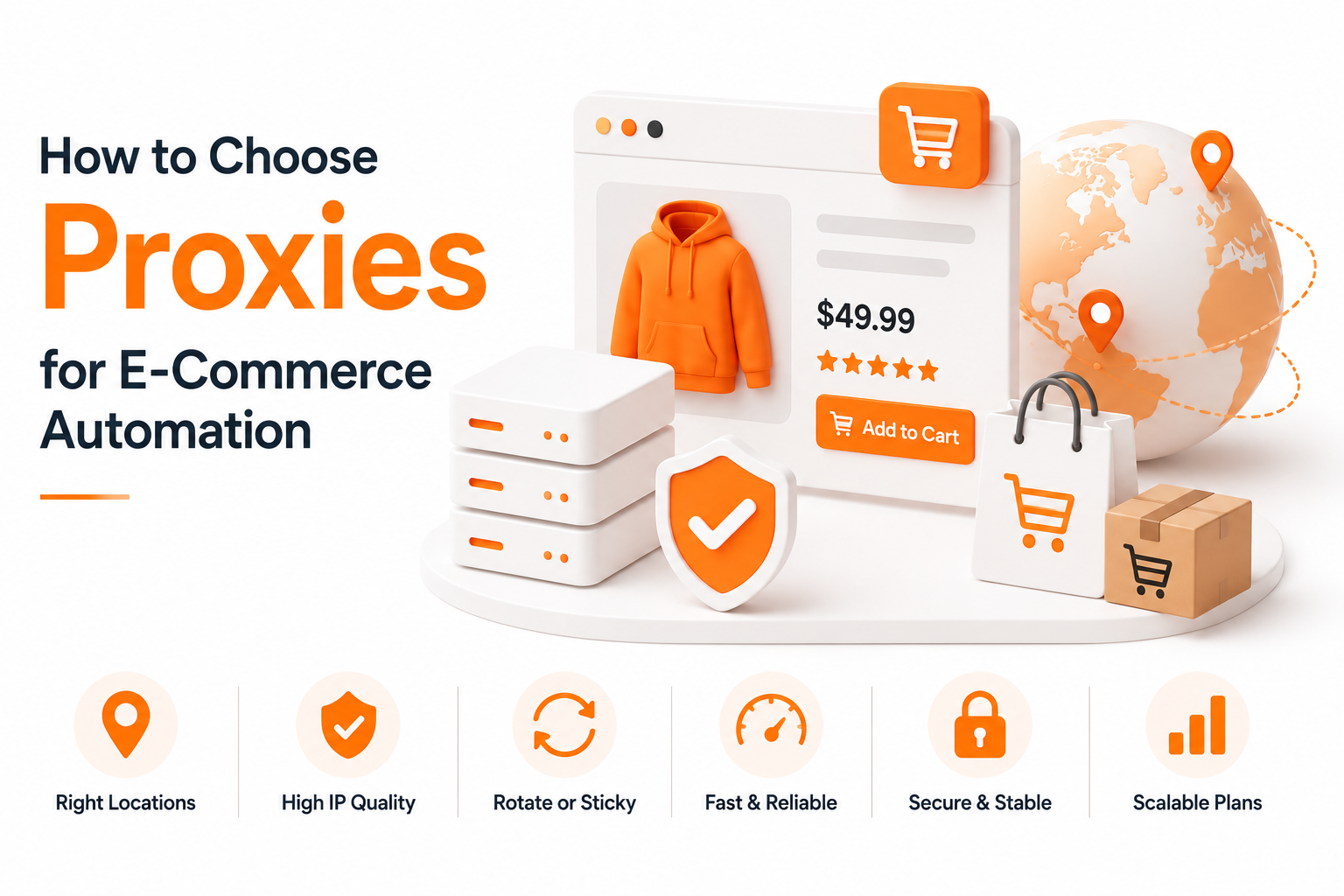
How to Choose Proxies for E-Commerce Automation
E-commerce automation is one of the most demanding proxy use cases in the industry. Unlike scraping a news site or rotating through public search results, marketplaces like Amazon, Walmart, Target, eBay, and TikTok Shop care deeply about *who* is connecting — not just *what* you're doing. They profile the network behind every request, link it to the account, and build a long-term trust score over weeks or months.
Choosing the wrong proxy type here doesn't just cause a CAPTCHA. It can suspend listings, freeze payouts, lock seller accounts, or block buyers from ever checking out again. This guide walks through how to think about proxies for real e-commerce workflows — without slipping into "bot territory" that platforms will eventually punish.
Why E-Commerce Is Different From Generic Scraping
Most scraping targets only validate the request. Marketplaces validate the identity:
- The IP's ASN (is it a known datacenter or residential ISP?)
- The IP's stability over time (does it stay with this account?)
- The geographic match between IP, payment, shipping, and device
- The browsing rhythm (how a real buyer or seller behaves)
- The age and reputation of the IP block
This is why a "fast rotating residential proxy" — perfect for SEO scraping — can be the worst choice for managing a Walmart Seller Center login. The IP changes mid-session, the ASN looks unfamiliar, the geolocation drifts, and the platform quietly downgrades the account's trust.
The right proxy for e-commerce is rarely the cheapest or the fastest. It's the one that looks most like a normal household or office connection that doesn't move.
The Three Proxy Types — and Where Each Fits
1. ISP (Static Residential) Proxies — The Default for E-Commerce
ISP proxies are residential IPs hosted in datacenters but registered under real consumer ISPs (Comcast, AT&T, Verizon, BT, Deutsche Telekom, etc.). To the marketplace, they look exactly like a home connection — but they have datacenter-level speed, uptime, and stickiness.
Why this matters for e-commerce:
- The IP stays the same for days, weeks, or months — exactly what a real household looks like.
- ASN belongs to a consumer ISP, not "Amazon AWS" or "DigitalOcean".
- Latency is low and bandwidth is unlimited — no failed image uploads, no half-loaded checkout pages.
- Perfect for account management, listing operations, order processing, ad campaign management, and long-running sessions.
This is the type IP Fist recommends as the primary network for any serious e-commerce operation. One account, one ISP IP, one consistent identity. That single rule prevents 80% of bans before they happen.
2. Residential (Rotating) Proxies — For Research and Discovery
Residential proxies route through actual end-user devices on real home Wi-Fi. They're slower and less predictable, but they offer something ISP can't: massive IP pools and precise geographic targeting down to the city level.
Use them for:
- Price monitoring and competitor research across regions
- Checking how a listing appears to buyers in different cities or countries
- Reviewing Amazon search rankings from a specific ZIP code
- Verifying ad placements on TikTok Shop or Walmart from different markets
- Any read-only workflow that benefits from scale and geo-variety
Never use rotating residential for logged-in account work. The IP changes, the session breaks, the trust score drops.
3. Datacenter Proxies — Rarely the Right Choice Here
Datacenter IPs are fast and cheap, but marketplaces recognize them immediately. Amazon and Walmart maintain huge ASN blocklists, and any login attempt from a known datacenter range is essentially a red flag waiting to happen. Use datacenter only for non-account tasks like public sitemap crawling, robots.txt checks, or internal health monitoring.
Matching Proxy Strategy to the Platform
Different marketplaces enforce different rules. Here's how to think about each:
Amazon (Seller Central, Buyer Accounts, PPC, Brand Registry)
Amazon is the strictest. They link IP, browser fingerprint, payment method, and shipping address into a single identity graph. Use ISP proxies, one IP per account, geolocated in the same country/state as the registered seller address. Never share an IP between two accounts you don't want linked.
Walmart Marketplace and Walmart.com
Walmart is aggressive about US-only access for sellers and shoppers. Foreign IPs (even clean residential ones) often get challenged. ISP in the US, matched to the account's state, is the safe path. For buyer flows and checkout testing, stick to the same city when possible.
Target
Target uses Akamai Bot Manager, which is one of the most sophisticated anti-bot stacks in retail. It heavily weights ASN reputation and TLS fingerprints. Always ISP for any logged-in or checkout flow. Rotating residential works for browsing public pages but will fail on checkout.
TikTok Shop
TikTok Shop combines TikTok's content-platform fingerprinting with marketplace risk controls. Account region matters enormously — a seller account registered in the UK should always connect from a UK ISP. Use country-matched ISP proxies and keep the same IP for the life of the account. Mobile-fingerprint browsers paired with ISP IPs are the cleanest combination.
eBay, Etsy, Shopify Stores
Slightly more forgiving, but the same principle holds: stable ISP per account, region-matched, no sharing across unrelated stores.
Practical Rules That Prevent 90% of Bans
A few habits that consistently keep accounts healthy:
- One account = one IP. Never log into Account A from an IP that has touched Account B.
- Country and state should match. A US seller logging in from a Frankfurt IP is an instant flag.
- Don't change the IP mid-session. Finish what you started on the IP you started with.
- Warm up new accounts slowly. Don't list 200 SKUs on day one from a brand-new IP.
- Avoid shared residential pools for logins. You don't know who else is on that IP this week.
- Keep cookies and IP paired. If the cookie persists, the IP should too.
- Don't run 50 concurrent operations on one account. Real sellers don't click that fast.
How IP Fist Fits Into E-Commerce Workflows
IP Fist offers both sides of what e-commerce operators actually need:
- ISP Proxies — clean static residential IPs across the US, UK, EU, Japan, and other key markets, with consumer-grade ASNs and unlimited bandwidth. These are the network layer for account management, listing, order ops, and ad campaigns.
- Residential Rotating Proxies — millions of real-device IPs with city-level targeting, for research, monitoring, and competitive intelligence.
- Sticky sessions from 1 to 120 minutes for workflows that need a stable identity for a defined window.
- Country and city-level targeting so the IP geography always matches the account.
For most e-commerce teams, the right setup is simple: ISP for the accounts, rotating residential for the research. Two products, one consistent identity discipline, and a much lower ban rate.
The Bottom Line
E-commerce isn't a scraping problem — it's a trust problem. The platforms aren't trying to stop traffic, they're trying to stop suspicious traffic. The cleaner and more stable your network looks, the less attention you attract.
If you only remember one thing: use ISP proxies as your default, keep one IP per account, and match the geography. Everything else is optimization on top of that foundation.